ir quality in China, France and the rest of the world has steadily improved over the past decade, yet the last-mile control of PM2.5 and ground-level ozone are proving to be the hardest. The two pollutants now rise and fall together under the growing influence of extreme weather, urban heat-islands and wild-fire plumes, making traditional single-species strategies obsolete. Meanwhile, cities are expected to reach carbon neutrality while still protecting public health—an ambition that demands both deeper scientific insight and faster, smarter action.
Artificial intelligence is emerging as the game-changer. High-resolution satellite constellations, dense low-cost sensor networks and chemical-transport models now produce terabytes of data every hour; machine-learning engines can digest these streams in real time to pinpoint emission hot-spots, forecast ozone exceedances down to city-block scale, and dynamically optimize traffic, industrial and agricultural interventions. Equally important, AI accelerates the discovery of unknown chemical regimes, quantifies health-damage functions for vulnerable groups, and designs least-cost pathways that cut CO2, CH4 and ozone precursors simultaneously.
The Sino-French Joint Workshop on Atmospheric Environment have been successfully held for eight times since 2008 (Beijing, Orléans, Qingdao, Lyon, Xi’an, Orléans, Chengdu, Bordeaux), they have provided the opportunity for fruitful cooperation among interdisciplinary scientists. Most of these workshops led to the publication of dedicated issues of Journal of Environmental Sciences (JES).
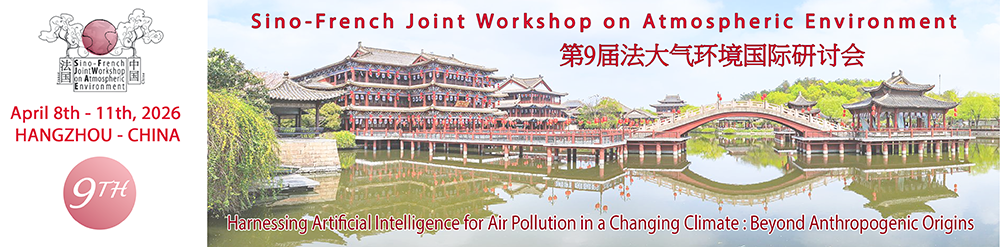
The 9th Sino-French Joint Workshop will be held on April 08-11, 2026 at Hangzhou, China, and will address different issues related to precision assessment and synergistic governance of air pollution and provide further forum for exchanging ideas about current research dealing with these issues.
While dedicated to Sino-French cooperation, this conference will be largely opened to participants from other countries, reflecting trans-boundary nature of atmospheric chemistry.
The topics to be addressed are:
· Pollution characteristics and sources apportionment of primary and secondary air pollutants.
· Physical, chemical processes and mechanisms of air pollution.
· AI-Driven approaches and big data to atmospheric environment challenges.
· Eco-environment influence and role of air masses from different origins on air pollution.
· Climate and health effects of air pollutants.
· Modification of air pollution features with climate change.
· Relative importance of anthropogenic vs biogenic sources and chemistry.
· Control technologies for primary and secondary air pollutants.
·Strategies, policies and measures for air pollution control under climate change.Trends, regulation and response of climate change.
NEWS
January 16th: Registration & Abstract soumission opening
 Loading...